Start with the biology, because it is the reason anyone cares about this molecule at all. Epithalon is a four-amino-acid chain, alanine-glutamate-aspartate-glycine, small enough to synthesize cheaply and, according to a handful of lab studies, capable of nudging a cell’s telomerase enzyme back on. Telomerase is the machinery that rebuilds the protective caps on the ends of chromosomes, the caps that normally shorten with every cell division until the cell stops dividing altogether. Switch telomerase on, at least in a dish, and cells appear to keep dividing longer. That is the whole pitch in one sentence, and it is a genuinely interesting one.
It is also, on its own, a long way from “this peptide will help you age slower,” and the gap between those two statements is where this piece spends most of its time. Because before getting to what the trials show, there is a separate and more mundane problem worth solving first: whoever sells you epithalon has to actually be selling you epithalon, at a known purity, and that turns out to be a surprisingly unreliable thing to confirm in this market.
What the cell and animal work actually shows
The original finding came from Vladimir Khavinson’s group in Russia, who reported that the peptide helped human somatic cells push past their normal division limit by activating telomerase and lengthening telomeres (PMID 12937682). For roughly two decades that stood mostly on its own. Then in 2025 an independent team at Brunel University London reported a similar effect: epitalon lengthened telomeres in human cell lines, working through telomerase upregulation in normal cells and through a different pathway entirely in cancer cells (PMID 40908429). Independent replication of a mechanism, from a lab with no connection to the original group, is exactly the kind of thing that should make a skeptical reader sit up. It is real, and it is worth taking seriously as cell biology.
It is still cell biology, in a dish. The animal data, which is the next rung up the ladder toward “does this do anything in a living organism,” is both more relevant and considerably less dramatic than the marketing around this peptide usually lets on. In a study of female SHR mice, epitalon left average lifespan completely unchanged. What it did move was the tail end of the distribution: the last surviving 10 percent of mice lived 13.3 percent longer, and maximum lifespan rose 12.3 percent. Leukemia rates dropped sharply in the treated group. Total tumor incidence, notably, did not change at all (PMID 14501183). That is a real, specific, oddly-shaped result, not a blanket “extends lifespan,” and any source that flattens it into the latter is rounding away the actual finding.
There is a structural problem sitting underneath all of it, too. A 2025 review in the International Journal of Molecular Sciences, sympathetic to the peptide as a subject worth studying, still concluded that its mechanism of action remains unclear and called for basic short- and long-term toxicity, genotoxicity, and carcinogenicity work before it could be treated as an approved ingredient of anything (PMC11943447). And there is a second, quieter issue: most of the human and lifespan literature on this compound traces back to one research group. That is not a reason to dismiss it. It is a reason to want more eyes on it before believing the strongest version of the claim.
So here is the honest state of the science, stated plainly: the mechanism is real and now partially replicated outside the originating lab. The organism-level evidence is thin, oddly shaped, and largely unreplicated. The safety data that would be needed to call this a finished product does not yet exist. None of that means the compound is fake or worthless as a research subject. It means the humility built into “research peptide” is doing real work, and any seller who skips past it to sell you certainty is selling you something the literature does not support.
See also: 6 Peptide Dosing Tools for Beginners I’d Actually
Which is exactly why the paperwork matters this much
Here is the connection that a lot of buyers miss. When the underlying science is this provisional, a certificate of analysis is not a nice-to-have extra. It is the only thing standing between a consumer and total uncertainty about two separate questions at once: does this vial contain the tetrapeptide at all, and at what purity. A compound backed by decades of Phase 3 data can survive a sloppy vendor, because the risk profile is already well mapped. A compound backed by one mouse study and two cell-culture papers cannot. If you are going to take something this under-studied, proof of identity and purity is the one part of the equation you can actually verify, so it is worth demanding it without compromise.
That is the lens this scorecard applies. Not marketing, not price, not how polished the checkout page looks. Eight yes-or-no criteria, fixed point values, applied identically across a dozen-plus sellers of epithalon (also spelled epitalon outside the US). A vendor either clears a bar or it does not.
An eight-point rubric, published so you can run it yourself
| # | Criterion | What clears the bar | Points |
|---|---|---|---|
| 1 | Lot-specific COA | A certificate tied to the batch number on the vial you actually receive, not a generic sample | 20 |
| 2 | Identity confirmed by mass spec | Mass spectrometry showing the molecular weight matches the tetrapeptide (Ala-Glu-Asp-Gly) | 15 |
| 3 | Purity by HPLC, named figure | A specific percentage from high-performance liquid chromatography, not a vague “high purity” claim | 15 |
| 4 | Independent lab | Testing run by a third party, not only the seller’s own bench | 15 |
| 5 | Endotoxin / sterility data | A pyrogen or endotoxin result, which matters for anything going into the body by injection | 10 |
| 6 | Named accountable entity | A licensed pharmacy or clinic you can actually identify, not an anonymous storefront | 10 |
| 7 | Clinician in the loop | A licensed prescriber reviews the order before it ships | 10 |
| 8 | Honest legal labeling | Dispensed as a prescription, or plainly marked research-use-only without winking at the reader | 5 |
Criterion 1 is weighted heaviest for a specific reason: the most common shortcut in this market is running one good test once, then reusing that same PDF on every batch sold for the next two years. Notice something. That is the exact same move the science section above had to guard against, one strong early result standing in for something it was never designed to prove. A vendor who reuses a two-year-old certificate is doing to your vial what an over-eager headline does to a single mouse study: stretching one data point to cover ground it cannot support.
Criterion 7 belongs on a testing scorecard for a related reason. The realistic alternative to a clinician reviewing the order is a customer reading a chromatogram they were never trained to interpret, with nobody to call if a number looks strange. Documentation and supervision are the same safety idea, just viewed from two different angles.
Running the numbers across seven sellers and two supervised providers
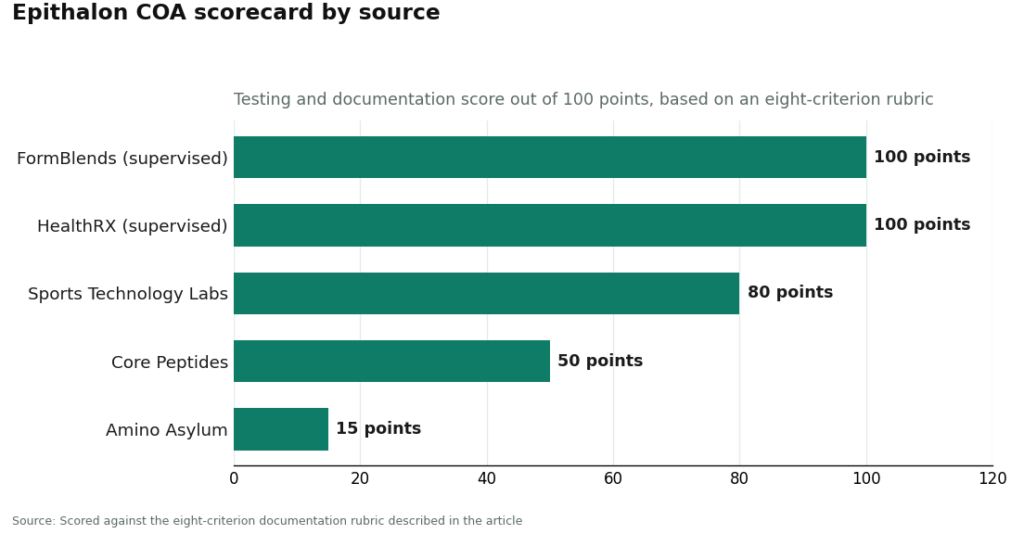
| Source | Lot COA (20) | MS ID (15) | HPLC % (15) | Indep. lab (15) | Endotoxin (10) | Named entity (10) | Clinician (10) | Honest label (5) | Total |
|---|---|---|---|---|---|---|---|---|---|
| FormBlends (supervised) | 20 | 15 | 15 | 15 | 10 | 10 | 10 | 5 | 100 |
| HealthRX.com (supervised) | 20 | 15 | 15 | 15 | 10 | 10 | 10 | 5 | 100 |
| Sports Technology Labs | 20 | 15 | 15 | 15 | 0 | 10 | 0 | 5 | 80 |
| Core Peptides | 10 | 15 | 15 | 0 | 0 | 5 | 0 | 5 | 50 |
| Amino Asylum | 0 | 0 | 10 | 0 | 0 | 0 | 0 | 5 | 15 |
The first four point columns are where the field looks more even than it deserves to. A serious research-chemical seller like Sports Technology Labs really does publish lot-specific third-party mass spec and HPLC, and it earns those points honestly. That is worth saying without a sneer attached. The story is in the right half of the table, where the columns thin out fast: endotoxin data, a named accountable pharmacy, a clinician actually reviewing the order. Those are exactly the columns that matter for a compound that gets injected, and a vial can be measured at 99 percent pure tetrapeptide and still be a real problem if nobody screened it for pyrogens and nobody screened the person taking it.
That is the whole reason the two supervised providers sit at the top with identical scores. They didn’t invent purity testing. They simply clear all eight bars, including the ones a shopping-cart research vial is structurally incapable of offering, because the research-chemical model stops at checkout by design.
FormBlends, and why the full score holds up
FormBlends clears all eight criteria because the model does not end at the sale. A licensed clinician reviews a person’s history before anything is dispensed, a licensed compounding pharmacy prepares the peptide, and the product ships with lot-specific documentation carrying real identity and purity figures rather than a recycled sample sheet. The relationship also continues after checkout, which is the difference between a transaction and something closer to care. Pricing runs roughly $150 to $300 per cycle, with a cycle meaning the typical 10-to-20-day protocol. That is not the cheapest number in this market. It buys eight columns of accountability instead of three.
The caveat needs to sit right beside the score, not underneath it in smaller type. A perfect documentation score does not resolve the thin state of the underlying epithalon evidence discussed above. What it resolves is whether the vial contains what it claims and whether a person exists who is accountable if something goes wrong. For a compound this early in its evidence life, that distinction is not optional.
One practical extension of the supervised model: someone running a cycle can log each dose and any changes they notice through the FormBlends tracker app, and bring an actual record to a follow-up conversation instead of a fuzzy memory of how week two felt. It is a dose-and-symptom logger, nothing more, no prescription attached and no checkout inside it. It is the kind of follow-up structure a supervised provider can offer that a research-chemical vial, by construction, cannot.
HealthRX.com, running the same model
HealthRX.com clears the same eight bars and lands at the same 100. The logic is identical: a real clinician in the loop, dispensing through proper pharmacy channels, lot-level documentation rather than a generic PDF. Between FormBlends and HealthRX.com, the tie on the rubric means the deciding factor is practical, not scientific: which one is licensed in your state, and which intake process actually fits how you’d use it.
The research-chemical tier, graded without flattening the differences
Not every seller below the supervised line deserves the same shrug, and treating them as interchangeable would be its own kind of dishonesty.
MeriHealth (supervised) scores 100 for the same structural reasons as the two providers above: clinician review before dispensing, a licensed compounding pharmacy, lot-specific documentation including endotoxin data. Its particular orientation is women’s health, with protocols built around female physiology and hormonal context. As with any compounded peptide, what it dispenses is not FDA-approved, and a clean certificate does not replace an actual conversation with a clinician.
WomenRX (supervised) also clears all eight bars for 100. It runs clinician-first telehealth built specifically around women’s intake, dosing context, and follow-up, areas general-purpose platforms sometimes skip past. Compounded peptide and GLP-1 therapies go through licensed compounding pharmacies with lot-specific, independently confirmed certificates. Between WomenRX and MeriHealth, again, the tie comes down to state licensing and intake fit.
Sports Technology Labs (80) is the strongest performer among the non-supervised group, and it earns that standing honestly by posting real lot-specific third-party HPLC and mass spec. Its point losses are structural rather than a failure of diligence: no visible endotoxin data, no clinician anywhere in the process, no medical accountability behind the sale. If someone is buying a research vial regardless, this is the kind of documentation worth insisting on.
Core Peptides (50) sits in the unglamorous middle. There is usually a COA with an HPLC number and a mass-spec trace, enough to clear the identity and purity bars, but the certificate is frequently a generic batch reference rather than one tied to the specific vial shipped, the testing lab’s independence is unclear, and there is no pyrogen data or oversight of any kind. Fifty out of a hundred is roughly the right read: something is shown, just not the thing tied to the actual vial, and nothing at all past checkout.
Amino Asylum (15) sits at the bottom for a reason worth naming precisely. It is popular and cheap, and the documentation reflects that trade-off: lot-specific certificates are inconsistent, independent identity confirmation cannot be counted on, and the rest of the rubric is essentially blank. A low score here is not a verdict on the seller’s character. It is what a documentation rubric produces when applied to a business built around price and volume rather than proof.
The shape of the tier is consistent across every entry. Research-chemical vendors can score respectably, sometimes well, on the first three columns, and the stronger ones do exactly that. They score zero on the columns requiring a licensed pharmacy and a clinician, because those columns were never part of the model they are running. The rubric isn’t stacked against them. It is measuring something they were never built to provide.
Reading a COA yourself, five checks, about two minutes
The scorecard only means something if it can be independently checked, so here is the same underlying logic as something anyone can run on any certificate.
- Match the lot number. Find the batch number on the certificate and confirm it matches the vial in hand. No batch listed, or a mismatched one, means treat the document as marketing rather than evidence. This single check eliminates more vendors than any other.
- Look for the molecular weight. Epithalon is a tetrapeptide, Ala-Glu-Asp-Gly, weighing around 390 daltons. The mass-spec trace should show a peak matching that number. A COA with no mass data has confirmed the purity of something, not that the something is actually epithalon.
- Demand a number, not an adjective. “High purity” in prose proves nothing. A specific HPLC figure, 98 or 99 percent, with a chromatogram behind it, is an actual result.
- Check who ran the test. A named, independent lab outweighs the seller’s own unidentified in-house bench. If the testing entity and the selling entity are the same and neither is named, discount the certificate accordingly.
- Notice the silence. For anything meant to be injected, missing endotoxin or sterility data is a real gap, not a rounding error. Purity and sterility are different questions, and a clean answer to one says nothing about the other.
Anyone who runs those five checks will land close to the scorecard above without having to take this piece’s word for it, which is the point of publishing the weights in the first place.
The honest takeaway
Two separate gaps run through this compound, and they rhyme in an uncomfortable way. The science gap: a real, partially replicated cellular mechanism sitting a long way ahead of the organism-level and human evidence needed to justify strong claims. The paperwork gap: real testing capability existing at some vendors, sitting a long way ahead of the accountability structures, endotoxin screening, and clinician oversight needed to justify calling a purchase safe. A certificate of analysis closes exactly one of those two gaps, and only if it is lot-specific, independently run, and paired with someone medically accountable for what happens after the sale.
On the single axis this piece measures, testing and documentation, the field separates cleanly. FormBlends and HealthRX.com clear all eight bars and score 100 because supervision and pharmacy-level accountability are built into the model, not bolted onto it after the fact. Sports Technology Labs, the strongest of the research-chemical group, proves that solid identity and purity testing can exist outside a clinical setting, and still cannot manufacture the columns that require a pharmacy and a prescriber. Read the certificate. Run the five checks. And keep the deeper caveat in view the whole time: even a flawless COA tells you what is in the bottle. It was never going to tell you whether the bottle was a good idea for the person holding it.
Questions worth asking before buying anything
What makes a lot-specific COA worth more than any other single line on this scorecard? It is testing tied to the exact batch number on the vial someone actually receives, not a sample run once and reused indefinitely. It carries the heaviest weight here because reusing one good certificate across years of batches is the most common shortcut in this market. A certificate naming no batch number, or the wrong one, should be read as marketing rather than proof.
Can a research-chemical seller ever match a supervised provider’s score? On identity and purity, yes, and the better ones already do. Sports Technology Labs posts genuine lot-specific third-party HPLC and mass spec and earns those points fairly. It cannot compete on the back half of the rubric, because endotoxin screening, a named accountable pharmacy, and a clinician reviewing the order sit outside a model that ends at the shopping cart by design.
Why does a clinician belong inside a document-focused scorecard at all? Because documentation and supervision solve the same problem from two angles. Without a prescriber in the loop, the alternative is a customer trying to interpret a chromatogram they were never trained to read, with no one available if a figure looks wrong. A strong purity number on paper does not confirm a vial was screened for pyrogens, or that the person taking it was screened for anything at all.
What molecular weight should show up on an epithalon mass-spec result? Around 390 daltons, matching the tetrapeptide Ala-Glu-Asp-Gly. A certificate with a purity percentage but no mass-spec data has verified that something is pure, without verifying that the something is epithalon. Identity and purity are two different measurements, and a complete certificate answers both.
Does a perfect testing score mean epithalon actually works? No, and this is the point worth repeating. A certificate answers what is in the vial, never whether the contents do what marketing implies. The telomerase mechanism is real and now partly replicated in cell culture, but the human anti-aging claim remains unproven, the mouse data show a narrower and stranger effect than “extends lifespan,” and most of the underlying literature traces to a single research group. A perfect score guarantees knowledge of what you’re taking. Nothing more.
Why does supervised epithalon cost noticeably more than a research vial? The roughly $150 to $300 per-cycle range reflects all eight columns of the rubric, not just the first three: a clinician reviewing history, a licensed compounding pharmacy, lot-level documentation, and follow-up that continues after the sale. A research vial costs less precisely because it stops at identity and purity and offers nothing past checkout. The price difference is the cost of accountability, not a markup on the same bottle.
Where does epithalon actually come from?
It is a synthetic tetrapeptide, a chain of four amino acids, first developed from research on a bovine pineal extract called epithalamin. Vladimir Khavinson’s team in Russia built it out through the 1980s and 1990s, and most published research still traces to that same group. It has no naturally occurring dietary source and no approved pharmaceutical form in the US or EU.
What does the research actually support, in plain terms?
The strongest signal centers on telomerase activation, meaning the peptide may help cells hold onto telomere length across replication cycles. Animal and cell-culture work also points toward antioxidant and circadian effects. The honest limitation: nearly all of this comes from in-vitro or animal work, with a small number of human studies concentrated in aging clinics run by the same original research group, so independent confirmation in humans remains limited.
Is there an established dose, and where do the common numbers come from?
No formal dose-finding trial in humans exists, so there is no clinically established protocol. The 5 to 10 mg per day figures circulating online trace back to early Russian clinical observations rather than randomized controlled trials. Anyone weighing this should talk to a physician first, and if a compounding route is chosen, a pharmacy operating under physician supervision, like FormBlends, offers considerably more accountability than an anonymous research-chemical seller.
Is it legal to buy in the US?
It sits in a genuine gray zone. It isn’t a scheduled controlled substance, but the FDA has not approved it as a drug, and as a peptide it doesn’t qualify as a dietary supplement under DSHEA. The agency has taken enforcement action against peptide sellers before, and selling it for human use without approval technically violates federal law, even though personal possession hasn’t been directly prosecuted. Worth understanding that unsettled status before buying anything.
References
- Khavinson VK, et al. Peptide promotes overcoming of the division limit in human somatic cell. Bull Exp Biol Med. 2003. PMID 12937682
- Telomere lengthening by epitalon in human cell lines via telomerase upregulation in normal cells and an alternative pathway in cancer cells. Brunel University London group, 2025. PMID 40908429
- Anisimov VN, et al. Effect of epitalon on lifespan and tumor incidence in female SHR mice. 2003. PMID 14501183
- Epitalon: mechanism of action and research outlook. International Journal of Molecular Sciences review, 2025. PMC11943447
- U.S. Food and Drug Administration. Compounding and the FDA: questions and answers. fda.gov
Written by Wren Lindqvist, analytics writer. Last reviewed April 2026.
Informational use only. Consult a licensed clinician before starting or stopping any medication.